
The 7 Stages of Dementia: A Gerontologist’s Guide for Families
The 7 Stages of Dementia A Gerontologist’s Guide for Families: California and Texas
Receiving a dementia diagnosis for a loved one can be overwhelming. Families often wonder what changes to expect, how quickly symptoms may progress, and when additional care may become necessary.

At The Way to Aging, we help families throughout Texas, California Orange County, San Diego, Los Angeles, Riverside and Inland Empire navigate the challenges of dementia every day. As a Gerontologist and former Executive Director of Assisted Living and Memory Care communities, I have guided countless families through the difficult decisions that often accompany cognitive decline.
While every person’s journey is unique, understanding the seven stages of dementia can help families prepare for future care needs and recognize when additional support may be beneficial.
What Are the 7 Stages of Dementia?
The seven stages of dementia are based on the Global Deterioration Scale (GDS), a tool used by healthcare professionals to describe the progression of cognitive decline.
Stage 1: No Cognitive Decline
During Stage 1, there are no noticeable symptoms of dementia. Memory, reasoning, and daily functioning remain normal.
Most individuals continue their usual activities without any signs of cognitive impairment.
Stage 2: Very Mild Cognitive Decline
At this stage, a person may occasionally forget names, misplace keys, or struggle to recall a word during conversation.
These changes are often attributed to normal aging and may not be noticeable to family members or healthcare providers.
Common signs include:
- Forgetting where items were placed
- Occasionally missing appointments
- Difficulty remembering names
- Mild memory lapses that do not affect daily life
Stage 3: Mild Cognitive Decline
Family members may begin noticing changes in memory and thinking abilities.
A loved one may have difficulty:
- Remembering recent conversations
- Finding the right words
- Managing complex tasks
- Staying organized
- Navigating unfamiliar locations
This stage is often referred to as Mild Cognitive Impairment (MCI) and may be the first time families become concerned.
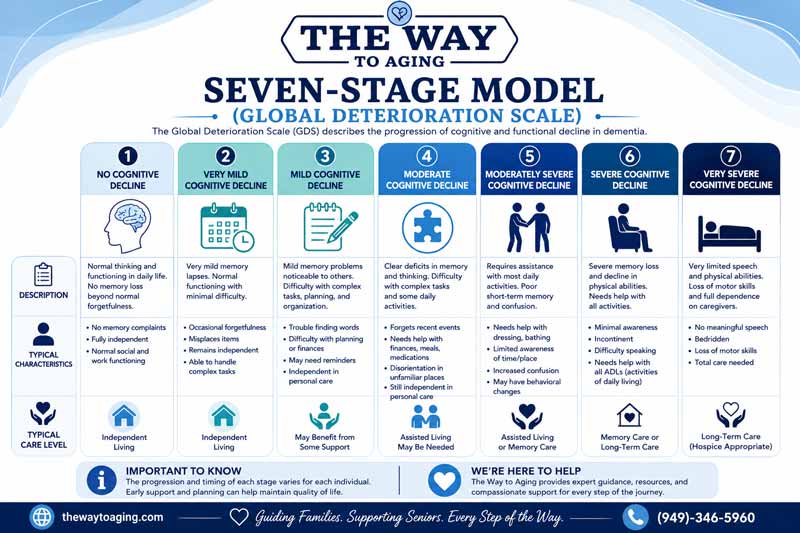
Stage 4: Moderate Cognitive Decline (Early Dementia)
At Stage 4, symptoms become more noticeable and may interfere with everyday activities.
Individuals may struggle with:
- Paying bills
- Managing finances
- Planning events
- Remembering recent events
- Completing complex tasks
This is often when a formal dementia diagnosis occurs.
Many families throughout Orange County, San Diego, Los Angeles, Riverside and Inland Empire families begin exploring home care options and future care planning during this stage.
Call Now 949-278-6181
Stage 5: Moderately Severe Cognitive Decline
As dementia progresses, a loved one may require assistance with daily activities.
Common symptoms include:
- Forgetting important personal information
- Increased confusion
- Difficulty selecting appropriate clothing
- Trouble remembering addresses or phone numbers
- Needing reminders for personal care
At The Way to Aging, many families contact us during this stage because caregiving demands begin increasing significantly.
Stage 6: Severe Cognitive Decline
Stage 6 often presents some of the most challenging symptoms for families.
A loved one may experience:
- Wandering
- Agitation or aggression
- Hallucinations
- Delusions
- Sleep disturbances
- Difficulty recognizing family members
- Incontinence
This is frequently when families begin considering specialized memory care communities or board and care homes that can provide 24-hour supervision.
Stage 7: Very Severe Cognitive Decline
The final stage of dementia involves significant cognitive and physical decline.
Individuals may:
- Lose the ability to communicate verbally
- Require assistance with all activities of daily living
- Lose mobility
- Experience difficulty swallowing
- Require full-time care
During this stage, families often work closely with healthcare providers, memory care professionals, and hospice teams to ensure comfort and dignity.
When Does Dementia Become a Crisis?
One of the most common questions we hear from Orange County families is:
“When is it time to get help?”
Dementia can become a crisis when a loved one’s safety or well-being is at risk.
Warning signs include:
- Wandering from home
- Aggressive behavior
- Hallucinations or paranoia
- Unsafe driving
- Frequent falls
- Medication mismanagement
- Caregiver burnout
- Repeated emergency room visits
When these situations occur, immediate intervention may be necessary to protect both the individual and their family caregivers.
Dementia Care Options in California and Texas
The right level of care depends on the stage of dementia and the individual’s specific needs.
Families may consider:
In-Home Care
Helpful during the earlier stages when assistance is needed with meals, transportation, medication reminders, or companionship.
Assisted Living
Appropriate for seniors who need daily support but do not require specialized memory care services.
Memory Care Communities
Designed specifically for individuals with Alzheimer’s disease and other forms of dementia. These communities provide structured programming, secure environments, and trained staff.
Residential Board and Care Homes
Smaller home-like settings that may be appropriate for seniors who benefit from a lower resident-to-caregiver ratio.
How The Way to Aging Helps California and Texas Families
Choosing the right care solution can feel overwhelming, especially during a dementia crisis.
The Way to Aging helps families throughout:
-
Orange County
Aliso Viejo, Anaheim, Anaheim Hills, Brea, Chino Hills, Corona, Costa Mesa, Cota De Coza, Dana Point, Fullerton, Fountain Valley, Huntington Beach, Irvine, Laguna Beach, Laguna Niguel , Laguna Woods, Lake Forest, Mission Viejo, Newport Beach, Rancho Santa Margarita, San Clemente, San Juan Capistrano, Santa Ana, Seal Beach, and Tustin
-
Inland Empire and San Bernardino , Riverside
Riverside, Corona, Moreno Valley, Temecula, Murrieta, Hemet, Perris, Eastvale, Menifee, Jurupa Valley, Beaumont, Banning, Norco, Wildomar, Coachella, Indio, Palm Desert, Cathedral City, Desert Hot Springs, La Quinta, Ontario, Rancho Cucamonga, Fontana
Chino, Chino Hills, Upland, Redlands, Colton, Rialto, Highland, Yucaipa, Loma Linda, Barstow, Big Bear Lake, Hesperia, Victorville, Apple Valley, Adelanto, Montclair, Grand Terrace, Twentynine Palms, Yucca Valley, Lake Elsinore.
-
Now Serving Texas
- Rockwall
- Plano
- Frisco
- Dallas
- Fort Worth
- Richardson
- Royse City
- Sherman
- Wylie
- Anna
- Heath
- Mesquite
- Richardson
- Allen
- Farmersville
- Princeton
- Prosper
- McKinney
- Mellissa
- Weatherford
- Rowlett
- Little Elm
- Celina
- Irving
- Midlothian
- Waxahachie
- Grapevine
- Greenville
- Aubrey
We evaluate your loved one’s needs, explain available care options, and help identify communities that match their medical, cognitive, social, and financial requirements.
Most importantly, our guidance is provided at no cost to families.
Speak With an California and Texas Dementia Care Specialist
If your loved one is experiencing memory loss, wandering, aggression, hallucinations, or other dementia-related challenges, The Way to Aging can help.
Before calling a community, call The Way to Aging. Our team can help you understand your options, avoid costly mistakes, and find the right level of care for your loved one’s current stage of dementia.
Contact The Way to Aging today for a complimentary consultation with an experienced Gerontologist and dementia care specialist.

Are Baby Boomers Better Off Financially Than Younger Generations?
Baby Boomers have lived through enormous economic and social changes. Born…

Complete Guide to Assisted Living Learn More
Call Now
Gerontologist | Founder & CEO, The Way to Aging
Yolanda Lawler, MASM,…